What is Precision Sheet Metal Fabrication Service? Understanding Its Core Benefits
From the smallest components in our electronics to the essential structures of our vehicles, precision sheet metal fabrication services are the unsung heroes of modern manufacturing. We’re talking about the art and science of transforming flat metal sheets into functional, high-quality parts with incredible accuracy and consistency.
Understanding what a precision sheet metal fabrication service entails, and more importantly, its core benefits, can truly revolutionize how businesses approach product development and production. Today, we'll explore why this specialized service is indispensable across various industries and how it ensures superior quality and efficiency.
Join us as we delve into the world of precision sheet metal fabrication services, uncovering the processes, technologies, and unparalleled advantages that make it a cornerstone of successful manufacturing projects.
Key Takeaways
- Definition of Precision: Precision sheet metal fabrication is a manufacturing process that converts flat metal sheets into parts that meet strict dimensional requirements and tight tolerances, emphasizing accuracy, consistency, and attention to detail. It is distinguished from standard fabrication not just by the tools used, but by the controlled and repeatable manner in which they are operated.
- Core Processes: The service is built on three main stages: high-accuracy cutting (using lasers, waterjets, or plasma), expert forming and bending (with CNC press brakes and stamping), and robust joining and finishing (through welding, riveting, powder coating, and more).
- Technological Integration: Modern precision fabrication heavily relies on advanced technologies like CAD/CAM software for design and simulation, CNC machinery for automated accuracy, and robotics to streamline production and ensure uniformity.
- Advantages of a One-Stop Service: Partnering with an integrated provider simplifies project management, reduces lead times, lowers costs by minimizing shipping and handoff errors, and ensures consistent quality control from prototyping to final inspection.
- Broad Industry Applications: This service is critical in sectors like aerospace, automotive, electronics, HVAC, and medical devices, where components must be lightweight, strong, and perfectly dimensioned to function correctly.
- Value of Partnership: Working with an expert provider offers more than just manufacturing; it provides access to Design for Manufacturability (DFM) support, material science expertise, and a commitment to quality assurance certified by standards like ISO 9001.
What Defines a Precision Sheet Metal Fabrication Service?
Precision sheet metal fabrication is the art and science of turning flat sheets of metal into complex, highly accurate components. It goes far beyond general metalworking by focusing on three guiding principles: dimensional accuracy, manufacturing consistency, and meticulous attention to detail. This process is essential for creating parts where tight tolerances and exact specifications are not just desired, but critical for the final product's assembly, function, and performance.
The Fundamentals of Precision Sheet Metal Fabrication Service
At its core, a precision sheet metal fabrication service is a manufacturing discipline that uses advanced techniques and machinery to shape metal sheets into parts with a high degree of accuracy and repeatability. Unlike standard fabrication, which may have more lenient variations, precision work operates within exceptionally tight tolerances, often as narrow as ±0.005 inches (±0.127 mm). This level of accuracy is what separates a functional part from a high-performance one.
The process is defined by its ability to consistently maintain these strict tolerances across every stage, from the initial cut to the final assembly. It addresses the challenge of "tolerance stack-up," where small, individual variations in each manufacturing step can accumulate, causing the final product to fail when integrated into a larger system. By controlling variation at every point, precision fabrication ensures that every component is virtually identical, which is crucial for large production runs and for parts used in high-stakes industries like aerospace and medical devices.
Achieving this requires a combination of several key elements:
- Advanced Technology: Utilizing computer-controlled equipment and sophisticated CAD/CAM software.
- Skilled Craftsmanship: Employing experienced technicians who understand material behavior and machine capabilities.
- Strict Quality Control: Implementing rigorous inspection processes, such as using coordinate measuring machines (CMMs), to verify dimensions against the original design.
Ultimately, precision sheet metal fabrication is not just about making a part to a specific dimension once; it's about reliably and repeatedly producing that part to the same exacting standard every single time.
Key Processes in Our Precision Sheet Metal Fabrication Service
The journey from a flat sheet of metal to a complex, three-dimensional part involves several highly controlled and specialized processes. Each step is critical for achieving the final product's required accuracy, strength, and finish. These core processes can be categorized into three main stages: cutting, forming, and joining/finishing.
Precision Cutting Techniques
The first step in any fabrication project is cutting the raw material to the specified size and shape. In precision services, this is accomplished using advanced, computer-controlled methods that ensure clean edges and tight tolerances. The choice of technique often depends on the material, thickness, and the complexity of the design.
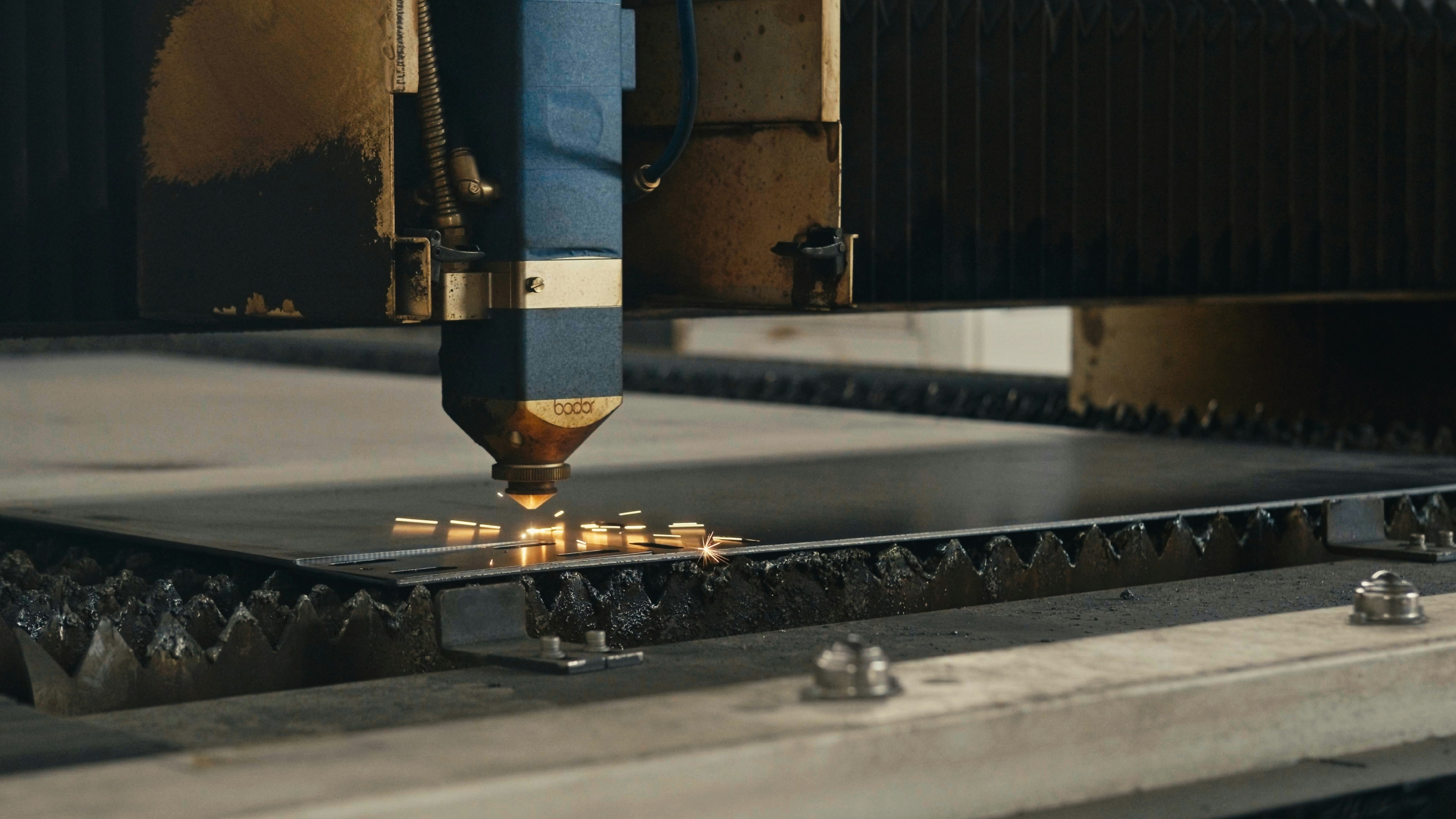
- Laser Cutting: This method uses a high-powered, focused laser beam to melt, burn, or vaporize the material with exceptional accuracy. It is known for producing extremely clean edges and minimal heat-affected zones (HAZ), which reduces material distortion. Laser cutting is incredibly fast on thin materials and is ideal for parts with intricate designs and tight tolerances, often achieving accuracy of 0.1mm or better. It is highly versatile, capable of cutting a wide range of materials including stainless steel, aluminum, and carbon steel.
- Waterjet Cutting: This technique employs a high-pressure stream of water, often mixed with an abrasive substance like garnet, to erode the material. A key advantage of waterjet cutting is that it's a cold-cutting process, meaning it generates no heat and therefore creates no HAZ or thermal distortion. This makes it perfect for heat-sensitive materials (like certain aluminum alloys or titanium) and for cutting very thick materials without compromising their structural integrity. While slower than laser cutting for thin sheets, a waterjet can cut almost any material, from metals to composites, glass, and stone.
- Plasma Cutting: This process uses a high-velocity jet of ionized gas (plasma) to melt and expel material from the cut. Plasma cutting is significantly faster than other methods on thick, conductive metals like steel and aluminum (often over 20mm). While it is more cost-effective for heavy plate fabrication, it produces a rougher edge finish and a larger HAZ compared to laser or waterjet, which may require secondary finishing operations.
Comparison of Precision Cutting Methods
| Feature | Laser Cutting | Waterjet Cutting | Plasma Cutting |
|---|---|---|---|
| Precision | Very High | High | Medium |
| Edge Finish | Smooth | Smooth (satin) | Rough |
| Heat-Affected Zone (HAZ) | Minimal | None | Significant |
| Material Thickness | Best for thin to medium | Excellent for very thick | Best for medium to thick |
| Speed | Very fast on thin materials | Slowest method | Fast on thick materials |
| Material Versatility | Wide (metals, some plastics) | Nearly all materials | Conductive metals only |
Expert Forming and Bending
Once the metal is cut into flat patterns, it must be formed into its three-dimensional shape. This is typically achieved through bending, a process that requires immense precision to ensure correct angles and dimensions.
- CNC Press Brake Forming: This is the cornerstone of modern metal bending. A press brake machine uses a punch and a die to bend sheet metal along a straight axis. In a CNC (Computer Numerical Control) press brake, the entire process is automated for superior repeatability and accuracy. The operator inputs the material type, thickness, and desired bend angles into the controller, and the machine's hydraulic ram and back-gauge position the sheet and apply the exact force needed for each bend.
- Common Bending Techniques:
- Air Bending: The punch presses the sheet into the V-die, but not all the way to the bottom. The final bend angle is determined by how deep the punch travels. This is the most common and flexible method, but it is subject to "springback"—the tendency of the material to partially return to its flat shape. Advanced CNC press brakes can automatically compensate for springback.
- Bottoming and Coining: In these methods, the punch forces the material to conform to the shape of the die. Coining uses extremely high pressure to stamp the material, resulting in a very precise angle with virtually no springback. However, it requires more force and can leave tool marks.
Joining and Finishing for Durability
After individual components are formed, they are often assembled into a larger structure. This joining process must be strong and precise, followed by finishing treatments that enhance durability, corrosion resistance, and aesthetics.
Joining Methods:
- Welding: This process fuses metal parts by melting them together, creating a permanent and very strong bond. The two primary methods for precision sheet metal are TIG and MIG welding.
- TIG (Tungsten Inert Gas) Welding: Known for its precision and clean, aesthetically pleasing welds, TIG welding offers the operator excellent control over heat. This makes it ideal for thin materials and for applications where the weld bead is visible, such as in stainless steel and aluminum products.
- MIG (Metal Inert Gas) Welding: This method is faster and easier to learn, making it highly efficient for production runs and thicker materials.
- Mechanical Fastening: Using rivets, bolts, and screws is another common method, especially when disassembly for service or repair is required. This method creates no thermal distortion and is easily inspected.
- Welding: This process fuses metal parts by melting them together, creating a permanent and very strong bond. The two primary methods for precision sheet metal are TIG and MIG welding.
Finishing Processes:
- Powder Coating: A dry powder is electrostatically applied to the metal surface and then cured with heat, forming a hard, durable finish that is much tougher than conventional paint. It offers excellent resistance to chipping and fading and is available in a vast range of colors and textures, making it ideal for steel enclosures, brackets, and frames.
- Anodizing: This electrochemical process is specific to aluminum and its alloys. It thickens the natural protective oxide layer on the surface, creating a finish that is integrated with the metal itself and will not chip or peel. Anodizing is prized for its exceptional hardness and abrasion resistance while maintaining tight dimensional tolerances, making it a preferred choice for high-performance precision parts.
Each of these processes—from the initial cut to the final coat—is meticulously controlled in a professional precision sheet metal fabrication service to ensure every part is a perfect reflection of its design.